Pages

Showing posts with label Sombre Soniks. Show all posts

Tuesday, 11 February 2020

Wotanist Affair - Jinthra


Album: Wotanist Affair
Artist: Jinthra
Label: Sombre Soniks
Catalogue no: SomSon146

Tracklist:
     1.      Garma
     2.      Notschrei
     3.      Odinvokation
     4.      Ragnarok


Jinthra is Jindřich Spilka, a ritual artist from Czechoslovakia, who is also the main protagonist behind Druhá Smrt, and for this particular solo project Spilka created a transformative and transgressive ritual designed to open up the pathways to the unconscious, enabling him to explore his own mythopoetical constructs and world-view. Wotan is merely the old Germanic form of Odin from Norse culture, and from an anthropological perspective the two cultures share much in common. It is eminently apparent from this recording that the old ways and their connections to notions of homeland and landscape, and the consequent supernatural forces at work through the deeply subterranean networks joining all creatures and things, are still very much in evidence and still exert a tremendous force. In fact, I have argued elsewhere that the resurgence of an adherence to and belief in these old cultural and religious ways is an antidote to the Christian directive to look up to some vague otherwhere that is apparently the abode of some all-powerful and singular deity, whereas paganism and its ilk connect directly to the life-forces of nature and power.


Given the above, where does Wotanist Affair fit into it? Track one, ‘Garma’, calls to the very powers that inform and animate the fabric of our earthly reality, with seismic drones that reverberate from deep below our feet. Those vibrations resonate deeply with our inner cores, both physically and metaphysically, initiating a very real connection that is as powerful and as alive as any spiritual force invoked through the spiritual offices of mankind. During the course of the track the tone subtly changes from one of subterrestrial darkness to one of uninhibited and invigorating power, the shifting tones dancing into the sky and bestowing their beneficences on all. Those blessings also infuse every fibre and cell of our own being, forcefully reminding us that we are not divorced from the world around us but are in fact an essential ingredient in its constitution, and that we should take our role very seriously.


‘Notschrei’ is next, a word which apparently means cry. The general tone displayed here suggests perhaps a cry of joy rather than of anguish, joy at receiving and fully participating in the panoply of nature and the forces governing them. I detected reverence and a certain strain of devotion here, a joyous welcoming with open arms to all the largesse that Mother Earth and Nature can give us. ‘Odinvokation’ is, perhaps, the ultimate result of welcoming and worshipping the natural forces that remain largely hidden from our purview – their effects are not bestowed carelessly but have to be earned, and establishing the conduits enabling the free exchange of power inevitably leads to a ‘conversation’ with Odin himself, the Allfather, and by doing so we have been welcomed into the family, so to speak. Swelling chords and drones pile one upon the other, building and accumulating energy and vitality, initiating change within oneself and bestowing awareness of what really goes on behind the veil.


‘Ragnarok’ carries with it visions of total apocalypse, annihilation, and utter destruction, but this isn’t necessarily so – it could mean an end to the old and the beginning of a new dispensation. In this context one could say this is the renewal of the self as a direct result of the encounter between oneself and the manifestation of the archetype that Odin/Oðinn/Wotan represents. Such an event is unlikely to leave one unaltered, at the very least affirming the existence of powers and entities beyond one’s conscious understanding, even if they’re the manifestations of subconscious realities. Again, these ideas are expressed in terms of swathes of high-flying chords, emerging from some deep chasm of the mind or earth, each one opening up to reveal something new, some new layer of knowledge of both self and universe, and entirely emblematic of necessary transformation.


When all is said and done, however, ritual is a completely personal pursuit – the human animal is as individual as the grains of sand on a beach, or the population of galaxies in the universe. Although rituals have always formed an essential part of mankind’s cerebral technology to enable him to make contact with essences and existences outside of normality, the most effective are those which are tailored to the individual. This series of four pieces shows exactly that – a self-realised enactment that was tuned into the celebrant’s own vision. But even on a superficial level, we are privy as listeners and observers to the workings of the imagination-rich inner world of Spilka and how it has shaped his worldview. Indeed, one could say that the release of this suite of music is an invitation, using this music as a basis, to join him in similar inner explorations.


Available as a download from here:


https://sombresoniks.bandcamp.com/album/wotanist-affair


Psymon Marshall 2020. 

Saturday, 25 January 2020

Akoustik Timbre Frekuency - Evolution [New Year Rite]


Album: Evolution [New Year Rite]
Artist: Akoustik Timbre Frekuency
Catalogue no: ATF03

Tracklist:
     1.      Evolution [New Year Rite]
     2.      Evolution [Isolated New Year Rite]


As a species, humans like to mark significant events or to memorialise changes whether they be something as small as a birthday, the supposed birth/martyrdom of a religious figure, or when the seasons morph into the one following. In tune with this innate drive many societies over the millennia have formulated rituals and ceremonies designed to celebrate these events, both as a means of marking them and of bringing together people as an act of societal cohesion. Even these outpourings of devotion have evolved, certainly in the private sphere anyway, as these days it appears that individuals are wont to craft specific rites to reflect personal connections and beliefs. This recent release from Akoustik Timbre Frekuency is one such, although strictly speaking this is a reissue that was released as a CDr many years ago by Quartier23 as part of their ‘Ritual Musick Series’. Evolution [New Year Rite] was originally recorded on New Year’s Eve seventeen years ago as a ritual performance and is now re-released as a two-tracker – the original release and the isolated audio recordings of the performance.

From the very note of track one, mournful howls and whistles portray the last throes of the old year, the slowly fading ghost of the presiding spirit of the journey around the sun just gone, as well as a cacophonous sending off as if to drive away an unwanted lingering guest. It’s extremely visceral, shamanic, and in the moment, a necessarily chaotic and unstructured approach in response to the celebrant’s immediate surroundings and the prevailing atmosphere, as much of a description and narrative of the inward forces moving the participants as it is of the event/performance itself. It’s also almost as if the ritual has manifested every denizen of the hidden dimensions into material form, and then given them licence to create merry havoc for the brief tenure of their corporeality. It’s simultaneously joyful yet dangerous, uplifting yet hair-raising. There are moments, especially towards the end of the track, where shivers ran up and down my spine, with a tingling frisson always present throughout the entire running time.

In direct contrast to the dense layering of the preceding track, the following isolated instantiation is stripped back completely and is, in some respects, much more primeval and subterranean, relying even more heavily on atmospherics plus an uncluttered, therefore more direct, approach to primal connections. Just like the treated track, there are entities here but they’re much more obscure and preternatural, scratching and skittering, harking back perhaps to a dreamtime before the world became as it is now. Those reverberations echo down through time from that deep past to the now, carrying with them the same primitive appeal and the same pregnant meanings, of the possibilities and potentialities of the new. If the previous was the seeing out of the old year, then this surely is the welcoming of the new one, an exhortation to embrace those proffered possibilities and potentialities with open arms. One can almost feel the weight of aeons in every guttural utterance and unidentifiable scratch and click on here, a crushing weight that says nothing more than humans are perhaps neither the first ones here nor the prime intelligence governing the globe. There are others ever-present, obscured behind veils only the sensitive and enlightened are able to see and comprehend. They are watching us, and perhaps judging us.

It would be fair to posit that this album fulfils the two sides of man’s nature – the bestial and the search for betterment. In essence, New Year’s Eve is supposed to delineate a moment of change, of forward movement, a reminder to look in front of us and not behind, that if we don’t make the attempt to evolve the human state to something more refined then we’re doomed to repeat the same old mistakes that we’ve always made. On a personal level (and very curiously) I felt this album deeply, in spite of trying to remain neutral as a reviewer. I suppose there are just some things that worm their way in and take up residence, whether they were given an invitation or otherwise.

Available as a digital album from here:

Psymon Marshall - 2020.

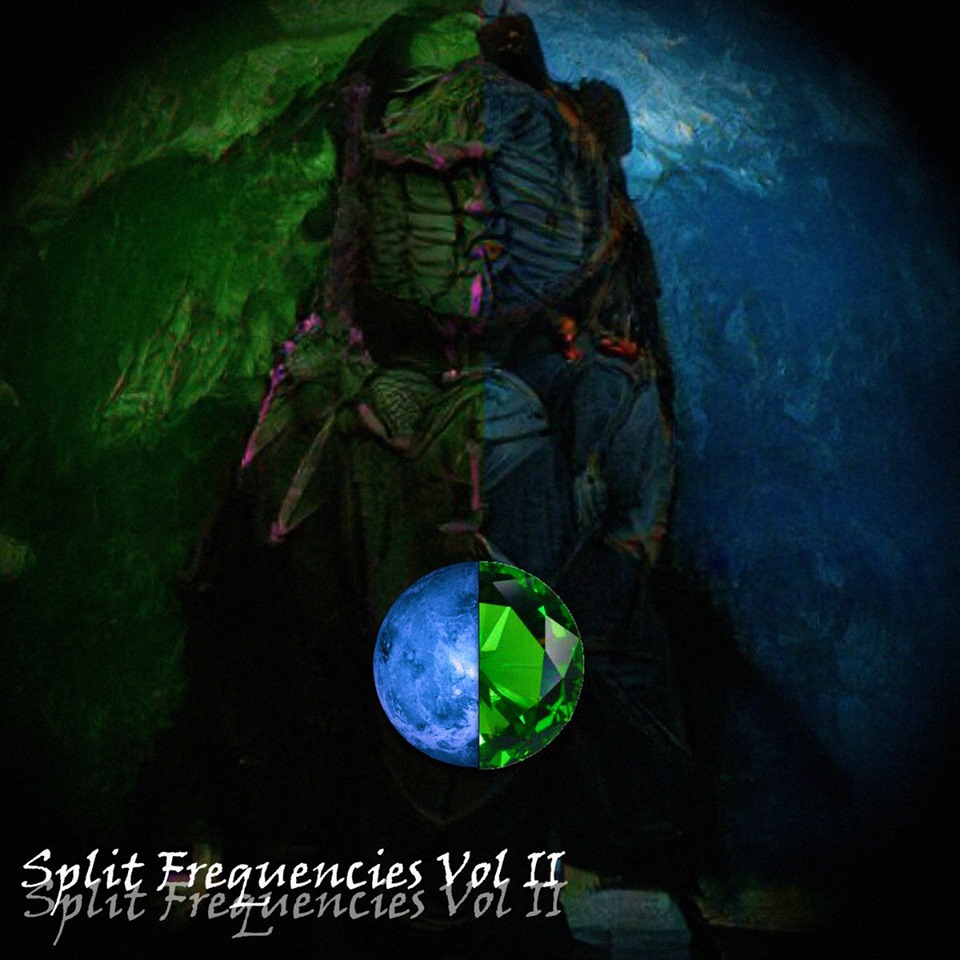
Split Frequencies Vol. II - Akoustik Timbre Frekuency/Temple Music.


Album: Split Frequencies Vol. II
Artist: Akoustik Timbre Frekuency/Temple Music
Catalogue no: SomSon 145

Tracklist:
     1.      Akoustik Timbre Frekuency – Atu XV: Thee Devil (Tiphaereth to Hod)
     2.      Temple Music – Ships/Arc


This most recent release from the prolific Sombre Soniks label is the second in the new series of splits showcasing two acts per release (I reviewed the first volume, featuring Embers Below Zero/Grist, at the end of last year). Volume II features Priapus 23’s Akoustik Timbre Frekuency backed by Alan Trench’s Temple Music. Along the same lines to the first, it contains two long-form tracks, about a half hour in length, thematically and atmospherically linked, and which also serve as a kind of an appetiser to encourage further explorations of their individual outputs. And my advice is to just sit back, wrap some headphones around your head, and let your pleasure centres and every cell in your body absorb the frequencies until you become diffuse matter.

ATF’s ‘Atu X: Thee Devil (Tiphaereth to Hod)’ gets on with it straightaway, opening with deep drones and resonant vibrations, meant to connect perhaps with the part of our brains that bypass the consensus reality we’re all subject to and instead injects us into an alternate existence where everything is possible, and where all angles converge. Atu XV: Thee Devil refers, of course, to the fifteenth card of the tarot’s major arcana, a card which strikes fear into many – however, it doesn’t necessarily mean death as it can also mean change (as in death of the old to make way for the new). The subtitle Tiphaereth to Hod is a reference to the kabbalistic Tree of Life, Tiphaereth being the sixth sephira that represents Balance, Integration, and Compassion amongst other attributes. Hod is the eighth sephira, having the attributes of Majesty Glory, and Splendour. The journey being described here is a descending one, possibly going through Netzach, the seventh sphere of Endurance and Patience, a descent from balance into the very earthly attributes of majesty and glory. It’s quite possible, then, that this track is in essence a travelogue, a diary if you like of the aspirant’s/adherent’s metaphysical travels whilst descending the Tree of Life: certainly, as the track progresses the sounds become denser and more layered, as well more resonant and noisier. Looked at from that angle, it becomes clear that we are climbing back down the rungs of the ladder that is the Tree of Life, from a higher more tenuous sphere into one of greater density and more materiality.

‘Ships/Arc’ is a different beast altogether, coming on like an early 70s psychedelic freakbeat workout with twangy bass and organ before more sonorous keyboard drones take over alongside crackles and reverberant background punctuations. Compared to ATF’s opener this begins from an earthbound viewpoint and gently takes flight to catch the thermals and soar above the banalities of material existence. It is at once majestic and plaintive, looking below and reaching up simultaneously, a feeling of both attachment and a longing to be free of unnecessary constraints or the encumbrances of gravity. A strain of melancholic whistling weaves itself above, through, and below the main drones, like a bird dancing amongst the clouds, flitting and flirting with the warm draughts and currents of air. Above is a clear sky, unmarked by any imperfection but, just like here on earth, it is forever unreachable. And, just like birds in this existence, we are drawn back to where we lifted off from, letting gravity take hold once more, and bringing us back to banality. However, unlike the material body, hope and promises aren’t subject to the same forces we are, and they continue soaring into the sky and beyond, catching and floating on currents we can never hope to ride.

Here we have perfect mirrors – one tending towards darkness and earthiness, and the other skywards. One is a reflection of the other, images and feelings that couldn’t exist without their opposites. Perhaps these two tracks are about balance then, about the need for it in a universe rife with plurality – it is in fact a cosmological imperative. Given the current imbalance of earthly life, this could be a warning perhaps, a reminder that without thiss much-needed balance then we are bound to invite our doom. Even knowing our negative propensities as a species, perhaps someone somewhere will listen to this and see the light switch on and receive epiphany. This release contains those depths and nuances aplenty, and they are open to those who will lend an ear.

Available as a digital download from the link below:

Psymon Marshall - 2020.

Wednesday, 4 December 2019

Embers Below Zero/Grist - Split Frequencies Vol. 1


Catalogue no: SomSon 141

Tracklist:
     1.      Concrete Elemental – Embers Below Zero
     2.      You are at the Gate, You are the Key – Grist


As the title of this new album from UK label Sombre Soniks suggests, this is the first in a new series featuring split releases, and on this one in particular we have two long-form pieces from projects hailing from Poland and Australia. Of course, the idea isn’t new, it being something of a tradition in certain underground music circles, but nevertheless it’s a welcome move on the part of the label. In many respects I prefer this format to the anthology/compilation: the flavour of an artist’s work can be gauged more fully through longer tracks than short pieces, at least in my books.

In light of that, then, what’s the prognosis here? Embers Below Zero’s ‘Concrete Elemental’ starts off with a distant but bright figure repeated until a raw static-infused wave fades in as if some hovering behemoth is crossing the distance between the far horizon and one’s immediate viewpoint, only to be superseded by an ambient drone that takes wing and soars heavenward. Whining guitar feedback accompanies the floating ambience, seguing into an ebbing and flowing organic rasp, reminiscent of something living and breathing, a steady, perhaps ultimately malign, presence, darkening the sky and casting its baleful aura earthward. It becomes the pulse of the piece, an elemental heartbeat giving life and sustenance to whatever entity has been conjured up. Strength and energy continually pile up upon themselves, sounding an alarm, signalling its immensely overwhelming power. Whatever species of entity hangs above our heads, it isn’t benign in any way, shape, or form, and even when it gradually fades we’re still left with the noisy ghost of its presence, an afterimage of darkness left on the pale azure of the sky, as a constant reminder.

Grist’s piece (‘You are at the Gate, You are the Key’) begins with the barking of a small dog (and, for a brief moment, I really thought it was a neighbour’s animal causing havoc), which, in some peculiar manner, reminds me of a guardian dog, like one of those that stand sentinel at the gates of a Buddhist temple. The barking is relatively brief, replaced by some quietly grandiose chords and a drum, gradually swelling in strength and distortion, indicative of the powerful currents of energy swirling around the sacred structure itself, agitating and driving the very air enveloping it. One can also imagine the cloud layer above it roiling frenetically, an inverted analogue of a choppy, storm-tossed sea, animated by the energies radiating outwards and upwards. To enhance the sacred flavour of the track even further a beat sequence reminiscent of tablas emerges, perhaps an accompaniment to a ritual dance being performed to win the favour of the gods. Smoke and incense pervade the temple, demarcating the boundaries of an extra-dimensional space in which nothing profane can exist, as well as acting as a meeting place where humans and deities can gather on equal terms and communicate in mutual understanding. There’s absolutely no doubting that the distorted guitar chords and organ swells, as well as the tones themselves, speak of the sacred, as well as the harmony of the spheres, and their overall effect is to elevate and to switch on and attune one’s mind to the cosmic. Like the title implies, our entry beyond the gate and access to the temple’s grounds are entirely dependent on the realisation that we hold the keys and always have done – we cannot ask the gods outright, as we must gain their trust and favour first. Even then, the ultimate goal isn’t guaranteed.

This first entry in the series is an unqualified winner and, if subsequent entries follow the quality on display here, then the label is assured a successful venture. Both can be classified as magnificent examples of the long-form drone/ritual ambient oeuvre, but it has to be said that of the two tracks the one by Grist just has the extremely slight edge for me, wrapping itself around my brain’s pleasure centres that particularly respond to this species of sacral, cosmic music. Even so however, it has to be noted that, for a brief moment, lasting no longer than the running time of the whole album, I was swept away from this dreary reality and transported to other realms, dimensions that I can only dream about. This music is music that can be felt and experienced rather than merely being heard, providing something of an immersive environment. Personally, I ask for nothing more from music than this.

Available as a download and stream from Sombre Sonik’s Bandcamp on the link below:

Psymon Marshall 2019. 

Friday, 25 October 2019

Syrinx - Dark Skies.


Album: Dark Skies
Artist: Syrinx
Catalogue no: SomSon 141

Tracklist:
     1.      Dark Fields
     2.      Glacier


Once again, I find myself in the universe of sounds promulgated by the Sombre Soniks label, this time courtesy of Syrinx. This project has already released two albums on the same label, but this is my first encounter with them. In contrast to many dark ambient acts this is a two tracker, for a combined total running time of over an hour. In many ways (and this is betraying my roots in the ‘alternative’ music genres) I find that longer tracks are much more conducive to allowing the artist to explore and expand on all the possibilities inherent in the themes they’re expounding, further allowing ideas and nuances to play bigger roles in enhancing and deepening the music.

‘Dark Fields’ is our entry point on this one, a distant drone hoving into view and slowly smothering the light, darkening the day, and stifling all colour and detail. Perhaps the sunset depicted on the cover provides a clue – within a short time these vibrant colours will have been extinguished and subsumed into the hues of night, the part of the daily cycle where all is hidden and obscured. Shimmering and ringing drones greet us as the sun goes down, perhaps leaving noctilucent clouds shining eerily high up in the atmosphere, their pale light not enough to illuminate anything but themselves. Soon colour has drained away completely, and mournful cello-like notes precipitate the appearance of fleetingly seen silhouettes, and shadows deeper than night itself flit rapidly between unfathomable pools of darkness. The stars appear dim tonight, their light lacking confidence, or perhaps it’s because they’re afraid of what they might witness and thereby tarnish themselves.

Night is a separation from the comforts of daylight, a time when vulnerabilities become sharper and more pronounced, and more keenly felt. It is the time of phantoms and ghosts, the time when, in the small hours, memories of our pasts often come unbidden, to haunt us like spectres of our fears and insecurities made manifest, to worry the edges of our consciousness and to pluck our nerve-strings. It is a time when all becomes magnified, when reason is sometimes overwhelmed by absurdity and insanity. At these moments we are most defenceless and open to outside influence – once the light returns, however, the phantoms fade away, leaving us wondering with incredulity at how we could have been taken in.

Saying that, ghosts do indeed walk abroad in this light-forsaken land – ragged spectral figures looking to attach themselves to any vulnerable person open to their malign intent. Their whispers and icy-cold fingers tap the nerves with chill purpose, sending tingles of alarm broadcasting through our systems. Those tiny trills attach themselves limpet-limpet to any perceived fear or vulnerability, no matter how small or insignificant. Then, it’s simply a matter of enlarging the fear out of all proportion to any kind of reality.

‘Glacier’ is chillier but still speaks of personal isolation and separation, mentally, physically, and spiritually. Here we’ve been deposited in the midst of a vast ice-field surrounded by sheer-faced glaciers, the ground at our feet extending on all sides to the roots of those massive glacial barriers nothing a blanket of white, its surface made into an unblemished sheet by the constant winds and daring us to besmirch its perfect banality. Up above, a startling azure sky, perfect in its clarity and lack of clouds, is outlined by the rim of the glaciers and arches overhead like an upturned china bowl. More than the fact that everywhere we look it’s exactly the same so that we are left unsure as to which direction to head in (if indeed there is anywhere to go) is the confusion as to how we got here in the first place – one minute it was all rosy and purposeful but when we looked up we discovered that the illusion had somehow been shattered and was replaced by the truth of things. It is only now that it dawns on us just how truly lonely we are.

Two long pieces, based around ideas on the themes of isolation and separation, and exploring every facet of what those two words mean. It’s a densely oppressive album, weighty in its explication of those terms, two relatively small words that carry such immense meaning. And to some out there, those meanings are not only felt but lived, ingrained into every fibre of their lives and being. If you’ve never experienced these feelings, then Syrinx’s Dark Skies will go a long way in bringing the listener a virtual recreation, a truly mood-suppressing vision of what it really feels like. As dark ambient goes, this truly is a black hole, mining the most numbing of human conditions and extracting its ores, and smelting them into something quite powerful. This is as black as it gets.

Available as a download from the Sombre Soniks Bandcamp page:

Psymon Marshall 2019. 

Saturday, 5 October 2019

Various - Dark Ambient Vol 18.


Album: Dark Ambient Vol 18
Artist: Various
Label: Sombre Soniks
Catalogue no: SomSon 140

Tracklist:
      1.      Akoustik Timbre Frekuency - Ὀϊζύς Rising
      2.      SIJ – Settle Clouds
      3.      Taphephobia – The Personification of the Dawn
      4.      Hellschreiber – Inside the Labyrinth
      5.      Cousin Silas – Tartarus Comes Up for Air
      6.      Babalith – Sapho
      7.      Tzii – Niké Itta
      8.      Temple Music – Io, a Fairytale Romance
      9.      Druhá Smrt – Nekromantaeon
    10.  Seesar – Hypnos
    11.  Alone in the Hollow Garden – Across the Abyss
    12.  Tribes of Medusa – Alone in Her Lair
    13.  Misantronics – Dark Areta
    14.  Black Seas of Infinity – Eruption of the Bleeding Oracles
    15.  Mørket – Nyx and Erebus
    16.  Bathory Legion – Ερμής
    17.  Grist – The Monster Inside thy Labyrinth (08.08.19)
    18.  Arcaïde – Hesiod’s Theogony
    19.  Embers Below Zero – Andromache’s Lament
    20.  Uzbazur – Battles of the Gods
    21.  [ówt krì] – Ascend to Light
    22.  Sheer Zed – The Sacred Lake of Crocodilopolis
    23.  Guy Harries – Minotaur


The latest volume in Sombre Sonik’s bi-annual compilation of the best of dark ambient has reached number 18, its coming of age so to speak. Most of the tracks I understand are unique to this collection, and some might even be foreshadowing future releases on the label. Any canny individual will discern from the track titles that its overarching theme is ancient Greek mythology, with all its attendant Gods, Goddesses, and Heroes. It must be borne in mind that, unlike say Ancient Egyptian deities who were remote and otherworldly, Greek deities were very much superhuman analogues of ordinary humans, especially in their actions and reactions, making them very relatable to us mortals (or certainly to ancient Greek mortals), their status as Gods and Goddesses the only thing that separated them from those ordinary human beings. Their lives were as complex and as simple as our lives were at that time, and that was one way for people to understand them.

Let’s plunge right in (but brace yourself because this is going to be a long one - apologies), and start at the very beginning with Akoustik Timbre Frekuency’s ‘Ὀϊζύς Rising’. Ὀϊζύς (Oizys) is the Goddess of Misery, Anxiety and Depression, being the daughter of Nyx (Goddess of Night) and the twin of Momos. Indeed, the atmosphere evoked here doesn’t much rise above subterranean rumbles and drones, eliciting an oppressive and browbeating weight that hangs heavily over the entire track. Strange disembodied voices emanate from beneath the black mists, presumably the denizens of some underworld realm. SIJ’s ‘Settle Clouds’ takes entirely a different tack, gloriously ambient chords launching themselves off a deeply elevating drone, to take flight and soar into a broad Mediterranean sky, the sun showering blessings on the Greek homeland. Greek myths could be full of cruelty, and yet could also portray incredible beauty and passion. The two tracks thus far encapsulate that dichotomy perfectly.

‘The Personification of the Dawn’ by Taphephobia carries us along on yet more high-flying chords and drones, as we float lightly and airily on invisible morning currents of wind while we witness the rising of the new day’s sun. Wispy white clouds brush our skin, their soft caresses as beautiful as soft maiden’s kisses. Hellschreiber offer us deeper, more sinister drones, as Theseus enters the Labyrinth, the domain of the Minotaur, whose grunting breaths are ever-present on this track. They’re a reminder of what’s in store at the centre of the puzzle, a bestial half-man, half-bull creature living in deep subterranean solitude, ready to accept tribute from King Minos every ninth year. Cousin Silas’ ‘Tartarus Comes up for Air’ burrows headlong into the earth on haunting drones, alighting in the deep caverns and chasms forever hidden from the light of day where souls are judged, punished, and tormented, the very same place where the Titans are forever imprisoned. It’s completely airless and subdued, a fitting dungeon for wrongdoers to find themselves trapped in.

‘Sapho’, by Babalith, is sinuous and snakelike, hypnotic and mesmerising like a snake-charmer’s flute. Sapho (or Sappho) was a female Greek poet from the island of Lesbos, who somehow became a symbol of lesbian love. Niké is the Greek Goddess of Victory (not a brand of trainers), and Tzii’s ‘Niké Itta’ track begins with a mass of reverberant tones overlaid with weird flute-like breathings, followed by forceful horn sounds shimmering through the air from afar. Perhaps a great victory has been won, and these are the annunciators of that triumph.

Next up is Temple Music’s ‘Io, a Fairytale Romance’ – the track is doubly appropriate here, as Temple Music is based on one of the Greek islands. As for Io, in legend she was one of Zeus’ mortal lovers, and became the progenitor of many kings and heroes. A voice from the depths of space and time emerges against a background of woodwind-type sounds, which change into drones and rumbles that build and build. The voice recites a story in Greek, presumably the story of Io and her divine romance. Druhá Smrt’s ‘Nekromantaeon’ presumably refers to the Necromanteion of Acheron, a temple devoted to Hades and Persephone. Suitably downbeat strings introduce the track, the chords as mournful and doleful as the region of death is itself, before the track opens out into grandiose sweeps of power and sound, indicative perhaps of the characters of Hades and Persephone. The contrasts couldn’t be more startling.

I reveiewed Seesar’s Ghoul-Kin earlier this year for this blog and, of all the tracks on show here, this project’s contribution is the most unique, insofar as it takes a very abstract approach to music. His ‘Hypnos’ is no exception, beginning with a series of reverberating scrapes and howls, personifying Hypnos’ role as the God of Sleep. However, sleep has many different states, from peaceful, to dreamful, to agitated and on to nightmarish, sometimes in the same night. This is reflected in Seesar’s lengthy track (coming in at just under 38 minutes), meaning that one can legitimately see this as a portrait of the God himself and his powers, in all his moods and caprices. This might just be one of my favourite tracks on here.  

Now comes an act I’ve heard of but not actually heard yet, Alone in the Hollow Garden – and their ‘Across the Abyss’ is a beautiful drone and voice affair, as if saying that if one speaks to the void then it will answer you. Following on from that is Tribes of Medusa’s ‘Alone in her Lair’, a sparkling fuzzed up guitar and drum paean to some unnamed female deity brooding in her secret sanctum. And broody it is too, the kind of brooding that certain-types engage in when they’re convinced that they’ve been wronged – there’s anger, envy, jealousy, and rage all wrapped up in here. Misantronics, another act with a recent release on the label (Initium), bring us ‘Dark Areta’, which initially starts with a low growling drone accompanied by howls and voice. This is a frigidly cold piece, reminding me of freezing winds blowing across a forsaken landscape.

Next up is Black Seas of Infinity’s ‘Eruption of the Bleeding Oracles’, a deeply Lovecraftian piece, with strange calls, rattling bones, and chill winds. This sounds as if it’s emerging from some deep pit, one that’s filled with poisonous vapours and sulphurous aromas. Mørket’s ‘Nyx and Erebus’ is next, a slow machine-gun electronic beat that echoes endlessly over its running time, oscillating, ebbing and flowing, waxing and waning. Nyx is the Greek Goddess of Night while Erebus personifies darkness and shadows, an appropriate companion to Nyx. Seemingly random notes serve as a prelude on Bathory Legion’s ‘Ερμής’ (which means Hermes), the God of trade, heralds, merchants, commerce, roads, thieves, trickery, sports, travellers, and athletes. He also acted as an emissary and messenger for the Gods. Stirring strings then pick up after the intro, focusing on the deity’s swiftness, before reverting to those random-appearing notes (they’re not, but give the appearance of being so). Australian outfit Grist is next with the second-longest track on the album, ‘The Monster Inside thy Labyrinth (08.08.19)’, announcing its presence with looping flutes and other woodwind instruments. Gradually these metamorphose into competing drones, reminding me somewhat of Steve Reich and Philip Glass. Beyond that it’s a complex, ever-changing track, forever evolving, roiling and coiling, having morphed into an entity far removed from what it was at the beginning.

We’re on the home straight now (and I thank you for your patience) and our next focus is on Arcaïde’s ‘Hesiod’s Theogony’ (Hesiod, by the way, was a poet active between 750 – 650 BC, contemporary with Homer of The Odyssey and The Iliad fame), which is a poetic work concerned with the origins of the world and the Gods. Indeed, the start sounds like the deep time before creation, the period when matter was diffuse and undifferentiated. Gradually, forms coalesce and assume their familiar shapes. The Gods become embodied too, and thus is our first mythology created.

Andromache was the wife of Hector, a soldier who was killed by Achilles, and here in Embers Below Zero’s entry she’s in the depths of lamenting his death. Swirling, plangent drones float on a breeze of grief, that same breeze taking Andromache’s tears with it. Uzbazur’s ‘Battles of the Gods’ burbles its way into existence on fierce winds, whilst being bolstered by a crackling hammered percussion, as Gods and Goddesses hurl thunderbolts at each other. [ówt krì]’s ‘Ascend to Light’ states its intentions with deep drones and ringing sheets of high-end sound, a spiritual flight through layers of gross matter that becomes diffuser and cleaner the higher we ascend. Grainy looping structures provide the bedrock for Sheer Zed’s ‘The Sacred Lake of Crocodilopolis’, which was a religious centre for the worship of Sobek, the Egyptian crocodile-headed God before it was taken over by the Greeks. It later became Arsinoë, named after Ptolemy 2 Philadelphus’ wife when he declared her its protector Goddess. Vaguely Eastern-style drones and figures elicit a sense of the exotic and mysterious, alluding to both the city itself and the sacred lake it sat next to.

And now, here we are at the very last track, Guy Harries’ ‘Minotaur’. We’ve already encountered the half-man, half-bull creature before in Hellschreiber’s track described above, but Harries describes the beast in very abstract terms, using resonant, oscillating drones and tones that convey the threat the creature represented. It ascends into a helicoptering blast of noise, a giant behemothic presence representing cruelty and danger, a block to anything resembling beauty or culture.

I apologise for the overlong review, but with compilations I feel that all participants’ efforts should be acknowledged. Luckily, however, I can honestly say that there were no duds on this one, but I would place as my particular highlights the contributions from Seesar and Guy Harries. I would venture to say that there’s something that will appeal to everyone on here, and as a name your price release, you can’t really go wrong, plus it represents excellent value. I urge you to pick this up, and give it a thorough listen – it deserves a careful listen and a lot of appreciation.

Get your copy from here:


Psymon Marshall 2019. 

Friday, 27 September 2019

A Most Accursed - Ghosts.


Album: Ghosts
Artist: A Most Accursed
Label: Sombre Soniks
Catalogue no: SomSon139

Tracklist:
     1.      Ghosts
     2.      White Cross
     3.      Rejoice
     4.      Wild River


I recently reviewed Druha Smrt’s latest release, Incarnatium, on this blog some weeks ago, and rated it as another entry in a distinguished catalogue of fine releases from the Sombre Soniks. So, you may justly wonder, what does this have to do with this latest release on this small British label? The answer’s simple: A Most Accursed is a side project of Druha Smrt, and takes matters off in a completely different direction from that project. Because what we have here can be classified as a form of shoegaze/noise/dark ambient hybrid: traditional instruments like piano and guitar are much in evidence, as are lyrics, and there’s plenty of reverb to go around. And it’s glorious – it’s dreamy and noisy, uplifting and shattering, light and dark, and pure delight.

The title track ‘Ghosts’ begins with a simple reverberating piano figure that provides a backdrop to breathy lyrics and guitar feedback. These are ghosts indeed, fleeting glimpses of lights and shapes seen from the corner of one’s eyes, distant elusive memories of past events and people long gone, seemingly recorded in a slice of air and time. Those memories haunt as shiveringly as spectres and apparitions do, living as they do in a past that can never be retrieved. ‘White Cross’ is just as mesmerising, echoey, ringing guitars and vocals rising into the sky, followed by soaring guitar notes winging their way to some distant, shimmering horizon. These are the bright but ephemeral sparks living their brief firefly existences in a vain effort to join the stars above.

‘Rejoice’ comes up next, more piano reverberations against a watery background, but this time accompanied by a mournful viola. This one, in spite of its title, is a swatch of darkness, velvety black and starless. A funereal pall hangs heavily, an oppression bearing down upon all who stand below. The final track ‘Wild River’ starts in much the same vein as the previous piece, with echoing bass piano notes set against rushing water, but don’t be fooled into thinking this is uncreative repetition. This one is lighter in tone, but grandiose in effect, indeed just like a wild river should be – bounded only by its natural banks, not beholden to the controlling interference of man, and left to power and meander its way wherever its nature wonts. Rocks and barriers mean nothing, and in many ways this serves as a metaphor perhaps for our own lives; the river fears nothing in its path, and can be a powerful force to be reckoned with. It could burst its banks and flood the land, destroying homes and lives. It bends and finds its way around obstacles. It is clear, hiding nothing. It is strong, supporting life, and simultaneously able to move heavy objects. It is the quintessential element for the survival of life.

In my so far short acquaintance with Sombre Soniks Ghosts amounts to quite a departure from their usual style, but I have to say that that is a wonderful thing. This is a more accessible album than much of their output, but is ultimately another means of expressing concepts which would be hard to pin down in any other way. It is an uplifting and sobering experience, a reminder both of joy and grief, a celebratory parade and a funeral cortege. Furthermore, this shows versatile musicianship, and that moods can be created both through tradition and unconventional means. This is a scintillating gem that shines darkly in both the light and the dark.

Available from the Sombre Soniks Bandcamp page:

Psymon Marshall 2019. 

Thursday, 26 September 2019

Deus Ex Charta - Earth Diver.


Album: Earth Diver
Artist: Deus Ex Charta
Label: Sombre Soniks
Catalogue no: SomSon138

Tracklist:
     1.      Our Kind of Hell
     2.      Thanatorgasm
     3.      Earth Diver


Sombre Soniks this month brings us another two new releases, both of which are side projects. The first of these is Deus Ex Charta, which is another incarnation of Serbian artist Timur Iskandarov, better known as Tamerlan. Here, the thesis and impetus behind the creation of this work is one that seems to be gaining ground in many quarters – the feeling that the way society has developed is inimical to humanity as a whole and that it’s failing both the people and the natural world it’s meant to protect. Add on to that conceptions of what ‘normality’ is defined as and its attendant strictures and regulations (whether legislated or otherwise) and slowly a large proportion of the Western world’s inhabitants are beginning to think that we must have gone wrong somewhere.

Indeed, if one looks back into our recent past, that feeling has always been there on the margins, and generally rejected by mainstream society. However, in the 21st century it appears to be breaking through those barriers and filtering through to the kinds of people who would never think of themselves as either rebels or protesters, leading them to opt out of ‘the rat race’ to live simpler, more satisfying lives away from the mad press of cities. And what Deus Ex Charta (which translates as ‘One Map’ –a particularly telling title if ever there was one) has done here is to simply boil down those feelings and intangibles of the whys and wherefores, and transposed them into a musical idiom.

Let’s start at the beginning with ‘Our Kind of Hell’, a chaotic mishmash of sounds and effects, none lasting more than a few seconds it appears, backed up by a constant but fractured beat. This is a pinpoint and accurate description of the state of civilisation in the 21st century – a turgid mass of endless communications, mobile phones, electronic devices, ninety-million channels on TV, the zombie-like hordes staring at screens all day, fast food, instant gratification, incels, 24hr media, mass travel, environment-disrupting industry, and our inane celebrity-worshipping culture. We’ve lost our connections to what’s actually important – the earth around us, people and community, the simpler facets of life. What we’ve created, in our inexorable march of ‘progress’, is indeed a species of Hell.


‘Thanatorgasm’ is our runaway consumption and embrace of this insipid and culturally-bankrupt culture, and doing so without batting an eyelid or thinking about consequences as long as it gives us a high. We’re faced with a high-pitched machine whine accompanied by rattles and a voice buried deep in the mix, but that voice doesn’t quite filter through, perhaps indicative of the lone voices of reason getting drowned out by the unheeding morass of humanity. It’s a thankless task trying to spread the truth to those who refuse to listen, or those who refuse to give up their toys.

The third track, ‘Earth Diver’, delineates what our response as a mature species should be – turn away, and look with new eyes at the bounties of nature, which are far more precious and less ephemeral than the trinkets that society tempts us with. Beginning with what sounds like a machine that’s been put out of commission, which is then superseded by a shining sustained guitar power-chord that sounds exactly like a horn announcing the coming of a new paradigm and dispensation, that the old is being replaced with a brand new relationship and understanding with Gaia. The sound rumbles on endlessly, its motion once started completely unstoppable, all the while building strength and power the longer it resounds. It’s a blanket of sound and energy, strong and wide enough to cover the entire world. It’s also transformative, just like a high tidal wave that cleanses the shoreline which leaves clean unblemished smooth sand once it’s retreated. There’s hope here in those soaring notes, and we should grab that hope, plant it, and watch it grow.

Sombre Soniks once again releases a thought-provoking set of music, one that perhaps is tinged with a certain urgency that impels action. I am continually astonished at P23’s ability to entice artists to produce such consistently high-quality work all the while releasing at least two downloads a month. But it also bears to be reminded that there’s a great deal of music out there by many obscure musicians who would be ignored by the mainstream taste arbiters of what we should be buying and listening to, and if not for the existence of such labels as Sombre Soniks this music would probably only remain circulated amongst friends and acquaintances. I suppose, then, that this is the supreme irony – the very machines of an errant society being used to disseminate the work of subversively creative and committed musicians who have essential things to say and shout about.

Excellent work!
Available as a download and stream from Sombre Sonik’s Bandcamp page:

Psymon Marshall 2019