Pages

Showing posts with label drone. Show all posts

Saturday, 16 November 2019

Nacht Und Nebel #2 – Limitations.


Nacht Und Nebel – Limitations – Cassette/Download – Self Released – 2018.

A1. Satin Skin.
A2. Silk Hair.
A3. Velvet Eyes.
A4. Sawdust Heart.

B2 cleansing.
B3. I awoke in a new body.


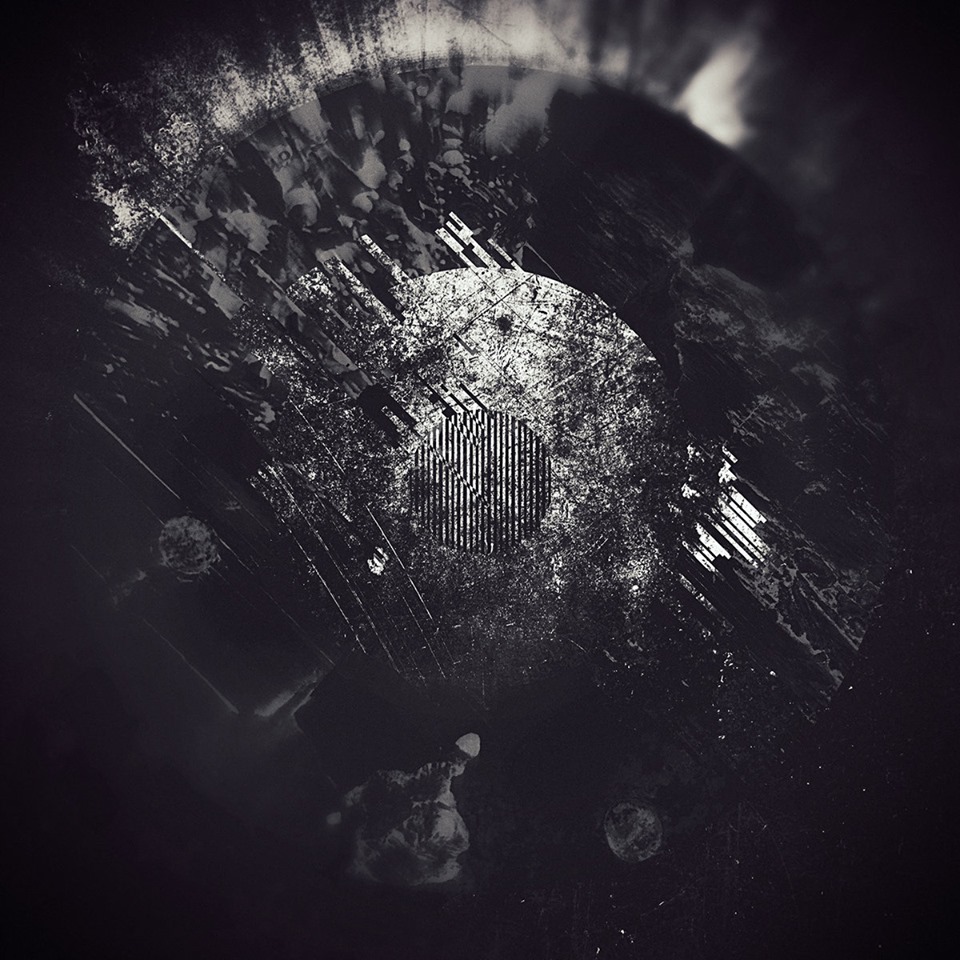
This cover is silver, the cassette is silver, it shines at you and reflects your image – a beautiful aesthetic object. Each side is marked by a green dot and a red dot and the titles appear to tell a story.

When I look at the cover of this cassette, I see a blurred reflection of myself, so does it represent a distortion of the self, by being reflected in the cover, does the listener become part of the album? Is this representative of being seduced/taken in and losing your sense of self in the process?

Feedback introduces Satin Skin as drones and pulsations begin to play along, the feedback soon becomes apparent Cello abuse that seems to multiply upon itself. The sound becomes urgent and gasping as humming feedback is all that stays constant until the repeatedly sound dies off, the Cello reappears clean during the spluttering and collapsing. I then feel as if I am in a David Lynch film during Silk Hair with the dominant sound being one of strings being hit as rumbling and crunch build around it. The distortion takes prominence as the strings begin to die off; this is deep in sound and resonates until the strings return. Both elements seem to play off each other for a long period of time. Is this the warping of desire?

A more aggressive urgency takes us into Velvet Eyes, there is a bigger build-up of distorted sound here. Some shoutier noise, whether vocal or Cello sourced I am unsure, but this is a much angrier, louder Nacht Und Nebel in play. Feedback and dying drones come in and out of the sound. Warped bursts of sounds and scratchy strings are Sawdust Heart, this track has an early 20th Century Avant Garde feel to it, chimes come in and a chaotic play off ensures. The chaotic nature of Sawdust Heart ensures it stands well against the intensity of earlier tracks.

The glory rays of the Brockengespenst seem to build up with each sound to form a collage of noises, eruptions and clangs that overlay each other - each resonation a new ray that intensifies the entire sound. The gradual build-up here is epic, eventually becoming violent and explosive with a slight restraint. The communication between elements of sound is ever present as if a conversation between characters or a display of emotions.  Cleansing seems to run with the violence of Brockengespenst and build on it. The sounds here contrast the main blasts are seriously processed as a Cello plays over the top of it, with all space filled by distortion – the play off is powerful. The background drones seem to eventually drive the whole piece in different directions.

The finale has its own identity and starts of subtle yet assertive in melody to signify the new start implied by the title. The strings that appear are strained as if to tie in with the intensity of the rest of the album, the pained distortion certainly do as a rebirth is hinted at through title and sound as it dramatically dies off.

This is an excellent cassette with a clear concept and delivery. The sonic communication is clear and focussed, the presentation perfect.

Nevis Kretini 2019

Thursday, 24 October 2019

Eisenlager - Schattenwölfe und Kraken


Artist: Eisenlager
Catalogue no: N/A

Tracklist:
     1.      Shae am Grünen Arm
     2.      Königsmund
     3.      Mätresse
     4.      Schwarzwasser
     5.      Turm der Hand
     6.      Im Roten Bergfried
     7.      Ich bin Euer, und ihr seid mein
     8.      Defensivtaktik
     9.      Tyrions Wutausbruch
    10.  Mein Löwe


If there’s anything I’ve learned with regards to Kalamine Records it’s to expect the unexpected, and this new one from Eisenlager was something I definitely wasn’t expecting. This drags us along into the territory marked on the map as experimental electro-acoustic, with side trips to ambient and noise, utilising all manner of artefacts and artifices to create truly weird and wonderful audio landscapes on worlds which are bizarre mirrors and inversions of the one we inhabit. It’s as if Eisenlager are inviting us to reflect upon our own environments, and then to contemplate how, with a slight twist of reality, things could potentially be so very different.

Take ‘Shae am Grünen Arm’ (Shae on the Green Arm), as a prime example, which just so happens to be the opening track. It begins with a distorted tinkling piano piece, presumably taken from an old vinyl record, before noisy rumblings come along and subsume it, interrupting the flow and completely inverting the mood. Gradually a mechanical rhythm takes over, reminding one of old-school industrial from the mid-nineties era, jerking and stuttering like some automated factory machine that’s been running for who knows how long and is on the verge of running out of power. It’s the sound of ordered decay, the steady dissolution of energy and movement, the powering down of obsolete technology perhaps. In complete contrast ‘Köningsmund’ (King[’s] Mouth) comes to us from the opposite end of the spectrum, even though it begins with a mishmash of samples and sounds until it broadens out into an ambient skyscape of blue horizons and rolling green hills. It shimmers and shines by its own neon-bright light, swirling and swooping endlessly, settling to earth and almost immediately taking flight again. As it progresses, however, there are signs of encroaching gloom appearing, as if saying that nothing is ever permanent or remains static, and that motion is perpetual.
 
‘Mätresse’ (‘Mistress’) is a curious concatenation of twinkling music box tinkles and stuttering electro beats, accompanied by miraculously hanging chords as if of some distant choir. This too is an open landscape, perhaps of a harmonious admixture of the old and the new, of technology and the organic and natural, where each element complements the other. ‘Schwartzwasser’ (Blackwater) is next, a sharp, nervous bag of urgent energy, all finely-honed edges and blade-like steeliness. Chaos, madness, and anarchy lie behind this, but something is just managing to contain it: even so it’s just waiting for some trigger to detonate it in one huge orgasmic explosion. ‘Turm der Hand’ (Tower of the Hand) is disorganised and atonal, at least initially, until it settles into a series of mesmerising echoes and reverberations, like drips of sparkling water. Again, this is a clean and clear landscape, a pristine untouched environment whose beauty is frozen both physically and metaphysically.

‘Im Roten Bergfried’ (In the Red Keep) suggests something grandiose, implacable, made of impregnable stone, and forever unassailable. From its trumpet and flute opening we get the feeling we’re approaching some old Schloss somewhere in the medieval heart of Germany, until almighty distorted guitar chords, entirely suggestive of heavy mass, weight (both physical weight and the weight of time), and solidity, rear up walls of impenetrability and permanency before our very eyes, taunting and daring us to tear them down.  ‘Ich bin Euer, und ihr seid mein’ (I am Yours, and You are Mine’) hoves into view next, shimmering dulcimer tones cascading over each other, like the expectant, trilling shivers one feels when in the presence of one’s soulmate. It even ends on a smooth, jazzy note.

‘Defensivtaktik’ (Defensive Tactics) wafts in on soaring and ringing notes, floating skywards and into the blue, almost in a shoegazy and languid style. It is breathtakingly beautiful up here in the clouds, and also breathtakingly cold. This is one way to avoid the teeming masses below, a way of asserting one’s personal freedoms and turning away from the collective madness that is ‘society’. ‘Tyrions Wutausbruch’ (Tyrion’s Outburst) is a stomping electronic pounding accompanied by urgent high notes falling over each other, a mass of pent-up energy and barely-contained frustration. I wonder if this is a reference to Game of Thrones by the way, as Tyrion Lannister is a main character in that drama…

And now to the longest track (and final) track on this album, ‘Mein Löwe’ (My Lion) which opens with a sweet ethereal Eno-esque ambience, which eventually gets backed up by a trippy, loping beat that sails along serenely on invisible airborne currents, lifting us up bodily from the sordid details of earthbound existence and into the rarefied heavenly realms. Stars twinkle at our onward progress, lighting our way, and guiding us ever forward. This is absolutely my favourite on this release, a high point in what is already an album of incredible quality, and is a sweet note to round off the set with. I certainly feel blissed out on the waves of soulfulness emanating from this magical construct.

Schattenwölfe und Kraken (Shadowwolves and Octopuses) is an album of contrasts, containing a broad spectrum of expressions and emotions, every one of which demands complete immersion and interaction from the listener. This a complete tapestry, delineating a wide range of human experiences and feelings, created by a master musician with an eye for fine detail and nuance, a sculptor of sound-material every bit as familiar with his medium as a carver is with wood or stone. When I say this is a stunning album, I mean it. When Eisenlager expounds his thesis of nothing is ever static, he carries it over into every composition – none of these tracks speaks of stasis or even of formula, just a direct conversation with the materials at his disposal. More than that however, is the fact that having the material is one thing, but being able to fully realise the potential of those materials is another. Eisenlager is a deft manipulator, knowing exactly how to extract the essence of each to best effect. Utterly bewitching and full of marvels.

Available as a digital download from the Kalamine Records Bandcamp page:

Psymon Marshall 2019. 

Wednesday, 18 September 2019

Musique Moléculaire - Iceberg


Album: Iceberg
Label: Self-released
Catalogue no: N/A

Tracklist:
     1.      Non-lieu
     2.      Angle Mort
     3.      Funérailles
     4.      Autopsie
     5.      Arcane
     6.      Subterfuge
     7.      Exogamique

I have to admit, for all that I like (and prefer) dark, loud, and often unlistenable music, there are occasions (like today, for instance) that I just want to be soothed by the strains of calming drones and soaring chord progressions rather than have my brains pummelled repeatedly by a metaphorical 2,500 ton forging press. I make no apologies for that. And this is exactly what I get from this album from Quebécois project Musique Moléculaire: a sonically diverse set of semi-improvised texturally-nuanced and descriptive pieces, set far above the madding crowd and in the subterranean deeps by turns. This is music one can melt into, and music which can induce shivers – and it deserves a broader audience, hence the review.

‘Non-lieu’ (Dismissal) is the permission granted for you to leave your physical body behind, and to let the astral construct whizz around the four-dimensional space that is the multiverse. Grand chords and drones lift the spirit, sending it flying upwards into the thermosphere and beyond, ejecting us from the prison of gravity and breaking the shackle binding us to earth. Once beyond our home planet’s grasp, the vista opens out, simultaneously exhilarating and terrifying, reducing the human scale to the ridiculous and infinitesimally small. ‘Angle Mort’ (Blind Spot) opens with drones that fan out in all directions, accompanied by a sweet refrain that genuinely sent shivers up and down my spine: now we’re in the regions where nebulae, dust clouds, and other assorted celestial oddities live, a boiling, roiling, and coiling riot of activity that can only be perceived on timescales far longer and bigger than we lowly humans can even conceive of. When one star blinks out, another star ignites into existence, and so it goes on.

‘Funérailles’ (Funeral) begins in elegiac style, composed of both hope and grief, a small light limning a dark horizon, before a thick pall of darkness descends, a stifling black essence snuffing out whatever light there is and diluting its brilliance. Death is a finality, a state of non-being from which no one can ever return, the mystery that awaits us all at the end of life. The vision presented is airless and lightless, a suffocating blanket of terrifying loneliness and distance, a chasm of separation that is unbridgeable. ‘Autopsie’ (Autopsie), follows on naturally – a reflection of the human desire to understand, to have things explained. It’s a sundering of the wholeness of the body, necessary perhaps, but for all that still a cutting of flesh to exhume a story and a reason, a forced ripping of soul from matter. It is not done for the dead person’s sake – it is entirely for those of us who still live. Death doesn’t matter to the dead.

‘Arcane’ is, perhaps, another logical follow-on – the unveiling of the ultimate mystery itself that exists beyond death, the secret puzzle that only the dead are allowed to witness. It’s a mystery that pervades all matter, from the lowliest component of matter to the vast conglomerations that coalesce as galaxies from myriad quantum complexities. ‘Subterfuge’ pulses in on metallic swellings and whines, before settling into plangent drones and reverberations, constantly twining and coiling, endlessly moving and sparking, and letting off energy in the form of a sequenced bass rhythm, which almost but not quite veers into EDM territory (I bear no shame in admitting I was nodding my head along with it at this point – no hip-shuffling though).

‘Exogamique’ (Exogamic) brings the album to a close, a series of reverberating notes fighting with both themselves and each other. It forms a curious but very mild atonality, setting the competing noises tumbling and cascading, to form strange waterfalls of noise. (Exogamy is the practice of marrying outside one’s group, tribe, or extended family relationships). The last few bars bring us almost full circle to a flavour of the beginning, the reverberations returning us to earth and the body. The circle is complete.

While this is in many ways closer to ambient than the dark variety don’t dismiss it on those grounds because there are streaks of darkness here aplenty. It’s a very literate form of music, the kind that plays with textures and moods to good effect, follows a well-plotted path with logical connections, and in the process forms narratives and stories, as well as painting vivid scenes and vignettes. It does so without superfluity or unnecessary flourishes, instead using a deft economy of less being more. This is one to which I will return, particularly because it shies away from the norms of conventional ambient and strays and wanders wherever it feels like going. I think the semi-improvisational nature helped enormously in helping to draw out the moods expatiated here, those dispositions ranging from cosmic soaring to plumbing the stygian depths. Like a good book, this has everything, and comes to a satisfying conclusion.

Available as a download from:

Psymon Marshall 2019. 

Thursday, 5 September 2019

Obsidian Ritual - Hymns for a Dead Sun.


Album: Hymns for a Dead Sun
Label: Self-released
Catalogue no: N/A

Tracklist:
     1.      Amongst the Astral Tombs
     2.      Ominous Signs
     3.      Voidsphere
     4.      Hyperborean Realms
     5.      Encroaching Draness, Encircling Wolves


Personally, I think it’s always good policy to write about not just the ‘big’ names in any scene, but also those who create in relative obscurity (just how relative is obscurity these days anyway, now that we have the internet?). Obsidian Ritual, whose Hymns for a Dead Sun is the subject of this review, hails from somewhere in California, and as far as I am aware this is his first full release. And, if you like your dark ambient with a touch of the cinematic about it, then I think you’ll like this.

‘Amongst the Astral Tombs’ sets the tone, with a deep bass rumble presaging mournful viola-like slow-bowed notes, evoking both a funereal claustrophobia and simultaneously a vast open space. Imagine yourself as an astronaut of the far future, coming upon a gargantuan necropolis out in the immensity of deep space, cyclopean edifices poised somewhere in one of an alien system’s Lagrange points, mammoth carved asteroid tombs adorned with indecipherable inscriptions. Are these the tombs of gods, or aliens? The stars look down coldly, bestowing little light and no warmth upon these structures – a sign, perhaps, that these graves are there for a reason, and that they are not looked upon with favour.

The freezing and deeply isolated ambience continues with ‘Ominous Signs’, a keening hymnal of cold wastes and methane-ice-covered lumps of rock circling a dead sun, the burnt-out hulk of which they still sullenly orbit. These vast ice-fields, wrapped in complete and utter dread silence, are home to nothing and no one, seemingly stretching out to an incalculable infinity – an emptiness that defies reason and dares anything or anyone to intrude upon its ages-long remoteness. ‘Voidsphere’ is the space between stars and galaxies, the incomprehensible distances beyond the understanding of tiny minds. A deep, boundless rumble announces its presence, an abyssal echo, an unleavened carpet of drone that’s spiked occasionally by a stray squeak here and there. This is colder than absolute zero, beyond which is a metaphysical quantum realm that rewrites the rules and dispenses with observed reality.

The hyperborean realms, here on Earth at least, were lands which were considered to be beyond the north, cold places that were completely outside the experiences of the peoples of ancient civilisation. In today’s global world, those realms have now moved into the darkness of space, the frigid wastes of airlessness and boundlessness. Temperatures here redefine the meaning of cold and frigidity, where nothing can survive. Grainy notes and faint bowed string-like notes reach our ears from unfathomable depths, accompanied by a seismic bass drone that speaks of inconceivable distances and the unimaginable vacuum of the universe. This space contains all that is and has ever been, and yet still has room for more, a fact illustrated by a tolling, echoing bell.

On the final track, ‘Encroaching Darkness, Encircling Wolves’, we’ve returned to the relative safety of Earth – relative because we’re ensconced in the northern wastes of this world, a place that harbours its own dangers. Earthy organ-style drones pulsate, ebbing in and out of time, until orchestral strings intervene and intertwine, a keening lament as mournful as the solitary wolf howling into the night. Lesser creatures run for cover but this is the wolf’s kingdom, his natural habitat, his rightful domain. His breath mists into the freezing air, a tangible sign of him giving voice to his declaration of his right to be here – his kind have lived here for untold millennia, and they have claim to this land. The moon looks down, satisfied with the wolf’s song, perhaps in part because they are close companions in darkness.

As some of you may have gathered by now, I have a penchant for the coldest of freezing ambiences, preferring them because they sing to my soul. This suite of tracks has been added to the library of virtual ambiences locked deeply inside the most inaccessible recesses of my brain, to be reinvigorated whenever I feel a longing for somewhere that’s isolated and remote. For those who like their ambient glacial and slow moving.

Give Obsidian Ritual some support by purchasing his download from here – it’ll only cost you a measly dollar:

Psymon Marshall 2019. 

Apocalypse Sounds- Promised Land


Artist: Apocalypse Sounds
Catalogue no:  N/A

Tracklist:
     1.      Part 1
     2.      Part 2
     3.      Part 3
     4.      Part 4
     5.      Part5
     6.      Part6
     7.      Part 7


I keep thinking that, in spite of being all too aware of the pervasively malignant aspects of the internet and its social media sites, I wish that I’d had access to such a platform back in the day when I started getting involved in the scene so that I could have happily wallowed amongst the contents of the treasure-chest of obscure and arcane music contained within it and the labels that release it. There are a lot of talented and passionate musicians who eschew the norms and rules that mainstream music appears to be following slavishly these days, and in consequence they’re free to create some of the most wonderfully abstruse, engaging, difficult, enraging, joyful, abstract, and challenging music, in the process questioning the very nature of what music is and what defines it. The point I am trying to make, albeit in a roundabout way, is that through social media (specifically a Facebook group) I came across this drone/noise ambient album Promised Land, and at the same time discovered the Barcelona-based Hamfuggi label.

Apocalyse Sounds is Arnaud Chatelard from the Bordeaux region of France, and the seven tracks on show here are perhaps reflective of Bordeaux itself. The climate there is described as ‘oceanic’ and it often tends more to feeling Mediterranean than other areas in similar climatic bands. To many, perhaps Chatelard himself, this is indeed a ‘promised land’.

I think that, luckily, because the tracks are titled as parts and not possessed of names, then this means the listener can imprint the pieces with their own interpretations. ‘Part 1’ fades in on a gentle drone which is joined by treated metallic sounds, the drone increasing in volume and intensity until it becomes a physical manifestation, hovering slab-like in the air, just above the cloud ceiling. It isn’t, however, static: it shimmers and pulses as if alive, its hulking presence neither threatening nor friendly, and it is both of, and apart from, the earth. Somehow it feels as it’s communicating with the land beneath its bulk, and that it’s doing so for a very important reason.

‘Part 2’ feels like quiet thunder rolling through the sky, a portent of something momentous that’s about to happen. It emanates from the presence hanging in the heavens, resounding in a continuous undulation of movement and existence. Its purpose: to cleanse, to purify, to sanctify, and to create. Eventually, the clouds, once grey and tinged with the promise of rain, now turn white and retreat, leaving in their wake the blue of Heaven. The land below reaches up its metaphorical arms, entreating the sun to bless it with its beneficence. ‘Part 3’ delineates the transformation of that land, a metamorphosis turning what was once barren and lifeless soil into a place of bounty. Green proliferates, and new life seeks new footholds. In ‘Part 4’ the ground has sensed the renewed energy flowing through it, and it greedily laps up whatever comes its way; as a consequence the very land is transformed too, moving with gentle heaves and slow-motion subsidences that lead to mounds and depressions, hills and valleys materialising to differentiate the topography. Specialised ecosystems evolve, and fecundity follows in their wake.

Life increases and expands exponentially, covering as much acreage as it can. Variety and speciation abound in ‘Part 5’, but there is a hint, albeit a minor one, that along with plenty comes poison: an unsettling undercurrent is somewhat apparent, running discreetly beneath the main narrative. Perhaps this is a necessity, a way of maintaining a measure of balance, as well as a warning – plenty leads to complacence and laziness. ‘Part 6’, although fading in very slowly with a treble-pitched drone that’s soon accompanied by a grinding bass counterpart, is perhaps re-emphasising that not all is as it appears in Paradise. The edges of Utopia are beginning to be slightly blackened – but that’s natural, as life itself is subject to death and decay, and this is a reminder.

To round the album off we have ‘Part 7’, and this one leaves us with a note of optimism, that in spite of any dangers present the Garden will survive and thrive, and that Paradise and all who live within her bounds will reap its benefits. There’s still that hint of caution, however, but there’s much less emphasis on it; the inhabitants will learn through experience how to navigate around the negative and rely on the positive. There is much of good service here, plenty enough to enable the fruits to bloom and develop.

I particularly liked this one, because it gave me room to interpret the music as my mind prompted me to, without any clues taken from track titles (apart from, perhaps, the album title itself). The vista presented here is as broad as the listener wishes it to be: the ‘promised land’ spoken of could be as small as a back garden or as expansive as a whole planet, depending entirely on the whim of the participant. And the listener is exactly that – a participant and a witness. The soundtrack inspires creation to flower in the mind, to stimulate virtual conception and generation into myriad forms, as many as the participant cares to imagine. Each track flows logically, one from the other, taking cues from the previous one to instigate its own narrative thread. Let’s just say that in my case, having the kind of imagination that I do, music like this allows me to germinate all those little potentialities lying dormant in the deep recesses of whatever part of the brain that allows visualisations to exist, and to let them bloom. And this collection of pieces was the substrate and nourishment that was all that was needed to spark off the nascent life into actuality.

Available as a download from Hamfuggi’s Bandcamp page:

Psymon Marshall 2019. 

Monday, 2 September 2019

DR - Tea Sessions.


Album: Tea Sessions
Artist: DR
Label: Kalamine Records
Catalogue no: N/A

Tracklist:
     1.      Kukicha Session
     2.      Pu Erh Session
     3.      Bai Mu Dan Session
     4.      Tie Guan Yin Session


Each of the track titles is a variety of tea, and I am going to hypothesise that each piece encapsulates the qualities of these varieties possesses. On the face of it, that may seem an absurd proposition, but judging solely from the music on here I would say that the idea is pretty damn close. And, on another note, so far I’ve been mightily impressed by netlabel Kalamine Records’ catalogue of releases, thoughtful music that tends to lean to the experimental, ambient, and dark ambient side of things, and may this streak of quality continue for many years.

So what liquid delicacies does DR serve up for our listening pleasure on this four-track mini-album? Session 1, Kukicha (also known as Twig Tea, being made from stems, stalks, and twigs), wafts into view on a pulsing organ chord, hovers idly but serenely just out of reach. There’s no doubting that this possesses marvellous meditative and uplifting qualities, in addition to being able to calm and soothe. This is perhaps reminiscent of a lazy day, with the sky purpling towards evening, wispy clouds beginning to blush pinkly, and a slightly chill breeze, and in the distance birds flying slowly and majestically towards home. Allow your thoughts to fly along with those birds, and see the world through their eyes.

Session 2, named Pu Erh (a tea made from the stems and leaves of the Camellia sinensis plant, the same from which green, oolong, and black teas are also made), roars in on a wave of sweetly distorted harmonic noise, which picks us up and sends us flying amongst the clouds and stars, propelling us upwards with spiralling, tumbling, swooping, and soaring turns. Immediately following on is Session 3, Bai Mu Dan (a white tea made from plucks of Camellia sinensis), is the dawn breaking and bringing colour flooding back into the world. A plucked acoustic guitar figure, accompanied by meandering high-flying string-like drones, welcomes the light as the sun peeks its head above the horizon, and the birds we saw flying home at sunset now make the journey to their feeding grounds, an equally grand sight as the night before.

Session 4, Tie Guan Yin (a premium type of Oolong tea, originating in the 19th century, also known as Iron Goddess), is the longest and richest track on here, reflecting perhaps the complexities of the palette of the tea itself. It introduces itself through a fluting drone, borne on the rays of the daytime sun, which beam down on us from the heavenly realms, suffusing and infusing all with its beneficent blessings. It shimmers and glistens, appearing both ephemeral and substantive, gauzy and solid, and it drifts placidly but purposefully through the sky. The harmonics here are gorgeous, as fine as silk, fluttering upon a breeze made of light and beauty.

They say that tea calms the mind and soul, and this album has exactly the same effect. Cares are strained away, leaving the body relaxed and the mind cleansed. There’s nothing much more I can say – at the end of a long day, this is all the refreshment one needs to soothe one into a state of blissful nirvana.

Available as a digital download only via Kalamine Records’ Bandcamp page:

Psymon Marshall 2019. 

Tuesday, 27 August 2019

Hiemal - The Seventh Continent

Album: The Seventh Continent
Artist: Hiemal
Label: Self-released
Catalogue no: N/A

Tracklist:
     1.      Glaciers and Antarctic Mountain Ridges
     2.      A Shipwreck by Polar Lights
     3.      Sheltered in a Frozen Cave
     4.      Drifting Icebergs by Nightfall
     5.      White Horizon, Black Waters


Hiemal appears to be quite a prolific gentleman, Bandcamp listing 53 releases of his, two of which came out this month (August 2019). I recently reviewed Shoreline Inertia, the first of those releases, and now along comes a second, The Seventh Continent. The term seventh continent is a real thing, referring to Antarctica – indeed Hiemal states that the inspirations for this five-tracker are the Endurance (1914 – Ernest Shackleton) and Terra Nova (1910–1913 – Robert Falcon Scott) expeditions to that continent at the bottom of the world, which is probably one of the most inhospitable places on the planet. And the one thing that truly emerges from this THREE hour album (apart from its brilliant value for money - just €5!) is just how microscopic we humans are in comparison to the magnitude of this last continent.

Opening proceedings is forty-six minute long ‘Glaciers and Antarctic Mountain Ridges’, a freezingly cold blast of frigid air, over which Sir Ranulph Fiennes describes Scott the man and his expedition in an interview (Fiennes himself is a noted explorer). That wintry backdrop is a portent of the tragedy that played out later, the insignificant human scale pitted against the immovable and implacable forces of nature native to the continent. Winds pile upon winds, battering and demolishing, stifling and pummelling relentlessly. And, having just introduced my new headphones to the wonders of dark ambient, the bass frequencies are absolutely seismic, physical entities in themselves, appearing able to move things just on their own. One can easily imagine vast chunks of glacial ice cracking and moving, fracturing off their parent walls of ice and plummeting into the seas. Seen in this context, is it any wonder that failure and tragedy more often than not accompanied those early expeditions?

Both sets of men were at the mercy of the elements which they couldn’t do much to counteract. ‘A Shipwreck by Polar Lights’, another 40+ minute epic, probably refers to the Endurance expedition, led by Shackleton, the ship ultimately being crushed by frozen sea-ice. Soaring flights of drones ride high above the ice-bound continent and into the unnaturally clear air, the wonders of the heavens twinkling unashamedly on the canvas of the night sky, the aurora shimmering and shimmying, lifting its skirts and moving to the music of the spheres, patently oblivious to the human drama unfolding below. The enchanting light-show, a marvellous wonder for a little while, would have paled by the time the expedition crew would have realised the situation they were in.

Then follows ‘Sheltered in a Frozen Cave’ and here the battering of the wind and elements has abated somewhat, at least for the time being, but it’s only warmer inside by a few degrees. Outside, though, it’s still an icy maelstrom of obliterating gales and white-out blizzards, a place where no unprepared human would last long. At times like this, one cannot do anything more than ponder on the fragility of existence: survival depends on so many factors, where an excess of one factor or the lack of another can mean the difference between living and dying. There must have been a point at which the crews of both ships would have wondered whether they’d ever make it out alive.

‘Drifting Icebergs by Nightfall’ must have presented a spectacular sight, floating mountains of ice sailing majestically past by the light of the stars, soundlessly and unstoppably, like ghostly ships. Stately high-flown washes and drones drift serenely past, just like the monoliths of compacted ice themselves, the silent waters carrying their bulk effortlessly and purposefully. And, finally, ‘White Horizon, Black Waters’, another long and epic track, sets down in sound the perfect summation of the continent and its immediate environs – vast open spaces of unbroken white stretching from one horizon to the other, often leading to snow-blindness where everything is covered in a disorientating blanket of white. The seas around the continent are another world, a dark wonderland that, like the rest of the world’s oceans, has yet to be fully explored. No wonder that HP Lovecraft set one of his Mythos stories, ‘At the Mountains of Madness’, on this continent.

The music on here, all three hours of it, reflects Antarctica itself, with its sweeping drones and heavy ambiences that appear to have no limits or end. In spite of the knowledge we’ve gained about most of the world we call home, the southern landmass is still a substantial mystery. The music here on The Seventh Continent carries with it a deep sense of the unfathomable and indecipherable enigma that is Antarctica, a place where very few have ever visited or are likely to visit. Above all, it delineates the immensity of the riddle of ice-enclosed geography that sits at the southern extreme, a puzzle that perhaps we might never solve. There are some who would say it would be better left that way.

Available as a digital download via Bandcamp on this link:
https://hiemalambient.bandcamp.com/album/the-seventh-continent

Psymon Marshall 2019.

Monday, 26 August 2019

Out of Hell - City of the Dead.


Album: City of the Dead 
Artist: Out of Hell 
Label: Self-released
Catalogue no: N/A

Tracklist:
     1.      Catacombs
     2.      Funeral Noir
     3.      Insomnia
     4.      Distant Dream


A short four-track album (or taster if you will) of the work of Swedish artist Boris Tyurin, of what could be termed deep dark horror ambient. What we have here are barren nuclear wastelands, denuded of vegetation and other forms of life, a hellish infertile desert dotted with the occasional rotted ruin of a shack or wind-pump, creaking forlornly in the radiation-filled wind of a winter unlooked for. The sky is black, with vast continent-covering clouds continually churning and boiling above, pent-up fury crackling in their every movement, relieved but rarely with a flash of lightning followed a few seconds later by rumbles and grumbles of anger and bitterness. This is a catalogue of beauty defiled and mortified, besmirched and dishonoured – a world, once filled with riches, now irrevocably reduced to rags.

The opening piece, ‘Catacombs’, begins with distant, keening winds, a lament for the wasteful and needless havoc that has been wreaked upon the planet. Voices accompany those winds, the ghosts of the innocents caught up in other people’s wars and skirmishes, a haunting refrain set to linger on for the millennia needed for nature to recover. Wandering shades weep black tears on ‘Funeral Noir’ which, falling upon the bare Earth, poison it still further. The cortege is an insubstantial parade, ragged, clothed in ripped and torn black robes, marching disconsolately to the metallic peal of a broken bell. There are no living creatures left to mourn the passing of Mother Earth, just the howling gales, or perhaps that sound is Cerberus, guarding the new Hades that Earth has become.

After the funeral comes ‘Insomnia’, the restless spirits of those still carrying their bitterness and animosity towards those responsible for the nuclear holocaust, when all they asked for was life. That has now become a ‘Distant Dream’, a cause now lost for the aeons to come. A lone peal and metallic scraping, set against a vast silence with only the soft sussurations of a breeze interrupting it, mourns for the vanished pearl of life that once bestowed its graces upon the world. That yearning is palpably real, the infinite spaces of an empty Earth keening for its glories to return.

As I’ve often noted, darkness doesn’t have to be portrayed in terms of loud, guttural rumbles or thunderous crashes in order to get its qualities across: quiet emptinesses can do the job just as effectively, if not more so. This is why I think City of the Dead works on the level it does – there’s the sense here that nothing has survived so there’s no one to be mourned or to mourn. The world has become a veritable irradiated Hell, only a place of ghosts robbed of its future. An introspective work that nevertheless poses some awkward questions about what it is we want as a species, who do we put our trust in, and how do we change the path we’re on so we head to a better and clearer destination? On top of that, it’s an astute observation of the current state of humanity – and it isn’t a particularly rosy summation at that.

Available as a digital download via Bandcamp on the link below:

Psymon Marshall 2019